
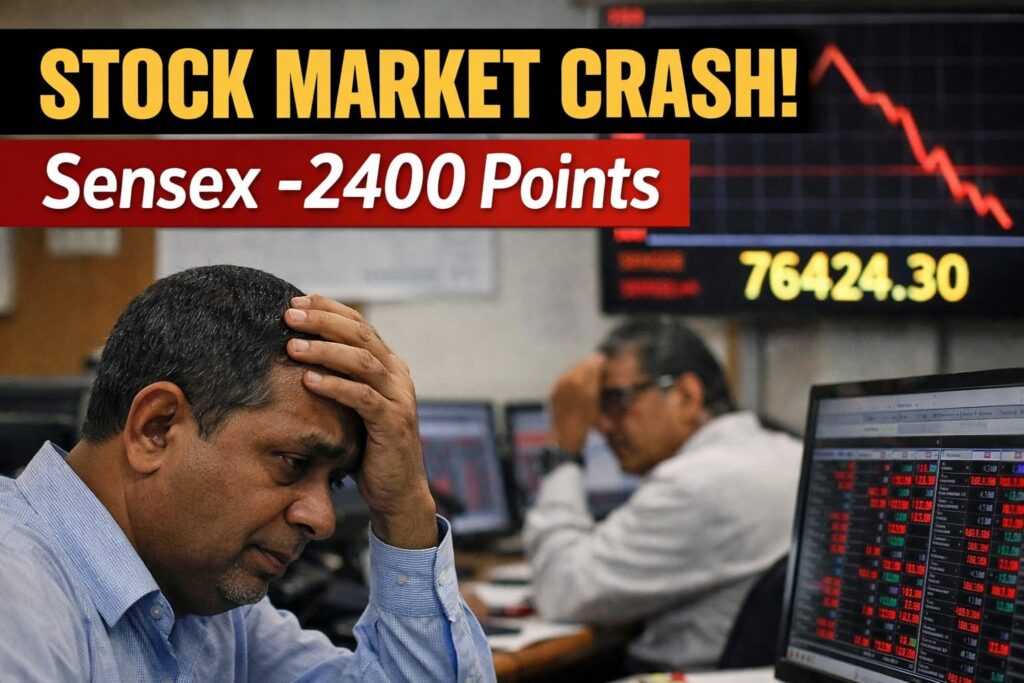
The Indian stock market opened with a sharp decline on Monday, reflecting panic in global financial markets. Both the Nifty 50 and Sensex experienced significant losses during early trading hours as global geopolitical tensions and falling international markets triggered selling pressure.
The fall was not limited to India. Major global markets including Japan, Hong Kong, and the United States also recorded steep declines, creating a ripple effect across Asian markets.
However, as trading progressed, the Indian market showed signs of partial recovery, giving investors some hope.
Massive Fall in Nifty and Sensex
At the opening bell, the Nifty 50 index slipped dramatically and dropped close to the 23,700 level, registering a decline of around 700 points during early trading.
Similarly, the Sensex, which had closed near 78,900 on the previous Friday, opened around 77,000 and quickly plunged further. Within minutes, the 30-share index fell by more than 2,400 points, touching approximately 76,424.
This kind of sudden drop created panic among investors and raised concerns about market stability.
Global Markets Trigger the Fall
One of the biggest reasons behind the fall in the Indian stock market was the sharp decline in global markets.
Key international indices also experienced heavy losses:
- Japan’s Nikkei Index dropped by nearly 4,000 points
- Hong Kong’s Hang Seng Index fell by around 800 points
- The Dow Jones in the United States closed down by about 453 points
When global markets decline simultaneously, it often leads to negative sentiment across financial markets worldwide. Indian markets reacted similarly due to this global pressure.
Rising Geopolitical Tensions
Another major factor impacting the market is rising geopolitical conflict in the Middle East.
Reports of attacks on oil depots and escalating tensions involving Iran, Israel, and the United States have created uncertainty in global financial markets.
Whenever geopolitical conflicts intensify, investors tend to move their money into safer assets rather than equities. This often leads to stock market volatility and sudden corrections.
Oil Prices Rising Toward $100 per Barrel
One of the most serious concerns for investors and policymakers is the sharp rise in crude oil prices.
Oil prices are reportedly approaching $100 per barrel, a level last seen in 2022.
Higher oil prices can create multiple economic problems:
- Increase in import costs
- Rise in inflation
- Pressure on government spending
- Higher transportation and manufacturing costs
Since India imports a large portion of its oil, rising crude prices can directly affect the country’s economy and financial markets.
Foreign Investors Pulling Out Funds
Foreign Institutional Investors (FIIs) are also playing a role in the market decline.
Due to global uncertainty, many foreign investors are withdrawing money from emerging markets like India. When FIIs sell large quantities of shares, the market experiences strong downward pressure.
This capital outflow adds to the volatility already caused by global tensions.
Can the Market Recover?
Despite the sharp fall, markets showed slight recovery during the day. As investors gradually analyzed the situation, panic selling slowed down.
Historically, markets often react strongly to sudden global events but may recover if tensions ease.
Experts believe that market stability will depend on several factors:
- De-escalation of geopolitical conflicts
- Stability in crude oil prices
- Return of foreign investments
- Positive global market sentiment
If these conditions improve, markets could regain momentum.
Uncertainty Still Remains
The biggest concern for investors right now is uncertainty. There is no clear indication of when geopolitical tensions might ease.
If conflicts continue or escalate, markets could remain volatile for a longer period. Investors should therefore remain cautious during such uncertain times.
Investment Disclaimer
This article is intended only for informational and educational purposes.
We do not recommend or support any stock market investment through this article. The stock market involves risk and volatility.
Any investment decision should be taken at your own risk and after proper research or consultation with a financial advisor.
Conclusion
The sharp fall in the Indian stock market reflects the impact of global uncertainty, geopolitical tensions, and rising oil prices. While partial recovery has been seen during the trading session, investors remain cautious due to ongoing international conflicts.
The coming days will be crucial in determining whether the market stabilizes or continues to face volatility.
Stay with us to know further updates.







Authentic News