Kashmir Terror Attack at Pahalgam: A Tragic and Targeted Attack by Terrorist
Terrorism, often debated as a religious or political ideology, is an overwhelming presence in many regions. One of the latest tragic examples came from Kashmir, where a ruthless terrorist attack recently targeted innocent tourist. The attack, which took place in the Basaran Valley, highlighted the horrifying reality of terrorism and its consequences on the lives of civilians.
A Harrowing Attack in Kashmir
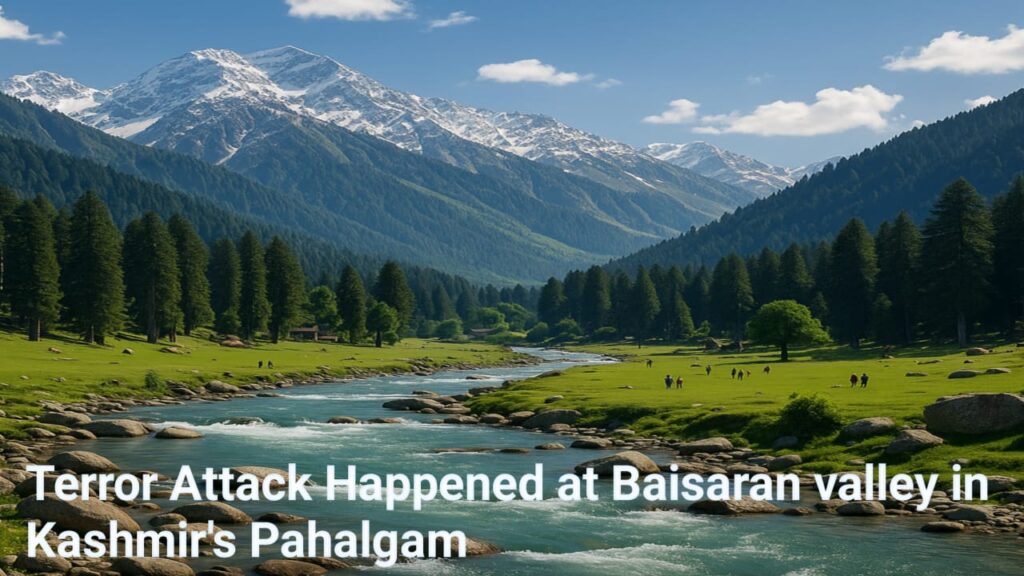
The peaceful valley of Baisaran, located off the main roads of Kashmir. You can easily reach only by foot. There is a deadly assault happened. Terrorists, reportedly armed, entered the area and opened fire on a group of tourists. Eyewitnesses claimed that the attackers specifically targeted non-Muslim tourists, shooting them at close range.
The aftermath was horrifying, with at least 20 people confirmed dead, and many others critically injured. Then survivors described scenes of chaos and fear, with some seeking medical assistance and others struggling to come to terms with the loss of loved ones.
A disturbing footage surfaced from the scene. It showed the aftermath of the attack. The haunting footage captured the chilling cries for help and the desperate search for survivors. It was clear that the attack was a calculated and brutal act of terrorism, aiming to instill fear and chaos.
The Group Behind the Kashmir Terror Attack
The group responsible for this attack was identified as the Resistance Front (TRF), an offshoot of Pakistan’s notorious Lashkar-e-Taliban. TRF emerged after the revocation of Article 370 in 2019, which stripped Jammu and Kashmir of its special status and statehood. This group’s primary aim is to destabilize the region and further the agenda of its masters in Pakistan. They are known for their violent tactics and have been linked to numerous attacks in the region.
Indian authorities have vowed to bring those responsible to justice. Prime Minister Narendra Modi, currently in Saudi Arabia, expressed his outrage, promising that the terrorists behind this heinous act would not be spared. He reaffirmed India’s commitment to fighting terrorism, emphasizing that such acts would not succeed in derailing the country’s resolve.
The Impact on Kashmir’s Tourism Industry
Kashmir, known for its picturesque beauty, has been witnessing a resurgence in tourism. In 2024, over 2.35 million tourists visited the region, a significant increase from the previous year. The rise in visitors signified a turning point for Kashmir’s economy, which had long been plagued by political instability and violence. Next the big companies were eyeing on investments, and elections had just been completed, with plans for a brighter future emerging.
But this deadly attack seeks to shatter the progress Kashmir had made. The terrorists’ goal was not just to kill but to instill fear and discourage people from visiting the region. Tourism, which had been thriving, now faces a bleak future as the violence has once again cast a dark shadow over the valley.
A Political Angle: Pakistan’s Role
This attack did not happen in isolation. Just days before, Pakistan’s army chief made inflammatory remarks, referring to Kashmir as the “jugular vein” of the country. This speech underscored the continuing tension between India and Pakistan over the Kashmir issue. With global attention in India, especially with the U.S. Vice President visiting at the time, the timing of the attack appeared to be no coincidence.
It is clear that the terrorists are not just acting on local grievances; they are part of a broader strategy aimed at undermining India’s sovereignty and destabilizing the region.
A Strategic Response
India’s response to this attack must be multifaceted. First, security must be checked again. Was there an intelligence lapse? Were security measures insufficient to prevent such an attack? These questions must be addressed to prevent future tragedies. Furthermore, India must continue its military efforts to neutralize terrorist threats in the region. It has worked hard to bring normalcy to Kashmir, and allowing these terrorist groups to succeed would undo years of progress.
Indian Government Announces Five Major Decisions: Impacting India-Pakistan Relations
In a significant move, the government has taken five major decisions aimed at redefining its diplomatic and strategic stance concerning Pakistan. These decisions may strongly affect relations between countries and the region.
Suspension of the Indus Water Treaty (1960)
In a historic step, the government has suspended the Indus Water Treaty signed with Pakistan in 1960. This agreement, which has governed the sharing of river waters between the two countries for decades, is now being terminated with immediate effect. Officials have stated that the decision reflects the changing geopolitical realities and national interest.
Closure of the Attari Integrated Check Post
The Attari Integrated Check Post (ICP), one of the primary land gateways for goods and people between India and Pakistan, is being shut down with immediate effect. This move will impact cross-border trade and people-to-people contact, signaling a hardening of India’s position.
Restrictions on Pakistani Citizens Under SAARC Visa Scheme
Effective immediately, Pakistani citizens will no longer be allowed to enter India under the SAARC Visa Exemption Scheme (SVES). Additionally, those who are currently in India under this scheme have been ordered to leave the country within 48 hours. This marks a significant tightening of visa policies with respect to Pakistan.
Expulsion of Pakistani Military Advisers
The government has declared all defense, military, naval, and air force advisers stationed at the Pakistani High Commission in New Delhi as persona non grata. They must leave the country in seven. This diplomatic action underscores India’s concerns over intelligence and military liaisons.
Withdrawal of Indian Military Advisers from Islamabad
In a reciprocal measure, India has recalled its defense, naval, and air force advisers from the Indian High Commission in Islamabad. This move marks a further cooling of diplomatic and military communication channels between the two countries.
PM Modi’s Strong Message After Kashmir Terror Attack
Prime Minister Narendra Modi, in a powerful statement after the Pahalgam terrorist attack, said, “The time has come to bring the culprits to the ground. The terrorists will get a punishment bigger than imagined.” He expressed the nation’s shared grief, noting how some lost their sons, some their brothers, and others their life partners—people from all corners of India, speaking Bengali, Kannada, Gujarati, or Bihari. Prime minister added that our anger is the same from Kargil to Kanyakumari.
Reaffirming India’s commitment, he added, “We will drive them to the last corner of the earth. Terrorism cannot break India’s soil. Terrorists will be punished. We will do everything to bring justice. The whole country is united in this resolve—every person who believes in humanity is with us.”
In 1960, PM Nehru and Ayub Khan signed the Indus Water Treaty in Karachi; in 2025, PM Modi’s government suspended it.
The Congress Leader Rahul Gandhi said: –
- He said, “We, as opposition parties, assure full support to the central government.”
- “We stand with the government to take any action against Pakistan,” stated Rahul Gandhi.
- He affirmed unity, saying national interest comes first.
- “There is no politics in national security priority of the nation first,” Rahul Gandhi emphasized.
- Rahul Gandhi assured the Centre of complete opposition support on action against Pakistan.
Jammu Kashmir (Chief Minister) said: –
I thank the people of Jammu and Kashmir for coming together after the attack and clearly saying they had no part in it. I request the rest of the country—please don’t treat Kashmiris as enemies. The people of Jammu and Kashmir want peaceful environment. What happened was not our choice, and if it were up to us, it would never have happened. We must move forward and overcome this.
- Omar Abdullah, Chief Minister of Jammu and Kashmir
The recent terrorist attack in Kashmir was a stark reminder of the brutality of terrorism and its devastating impact on innocent lives. While the attack has left the region in shock, it also serves as a call to action. India must strengthen its resolve against terrorism, enhance security measures, and ensure that the terrorists responsible for these horrific acts are brought to justice. As Kashmir continues to fight for peace, the world must stand in solidarity, recognizing the true face of terrorism: a force that seeks to destroy not just lives but hope itself.