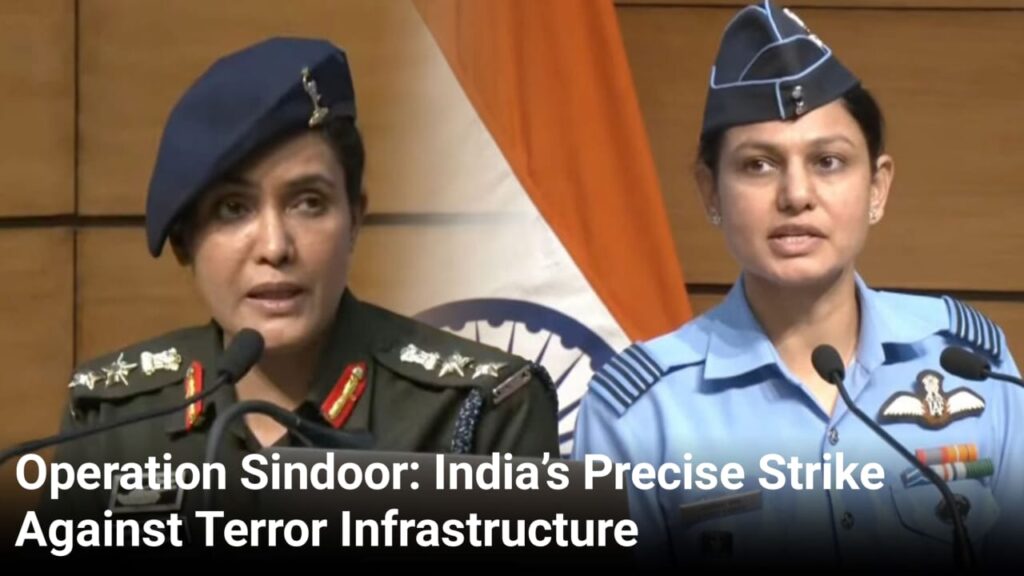
Operation Sindoor: India’s Precise Strike Against Terror Infrastructure, Women Officers brief the Press. The government said the hits had devastated the camp where terrorists Ajmal Kasab and David Headly had trained.
On a tense night, the Indian defense establishment unveiled the details of a significant military operation—Operation Sindoor. Initially, fragmented reports from the media caused speculation and confusion. However, an official press briefing provided a comprehensive and coordinated account of the operation that targeted terrorist camps in Pakistan and Pakistan-occupied Kashmir (PoK).
A Coordinated Precision Strike
Contrary to assumptions of a random attack, Operation Sindoor was a meticulously planned and executed mission. Each target was carefully selected based on strategic and intelligence inputs, and the operation was carried out with remarkable precision to minimize civilian casualties. The Indian Armed Forces demonstrated their advanced capabilities in both coordination and execution.
Women at the Forefront: A Historic Briefing
In a notable move, the Indian military deployed senior women officers for the press briefing. Colonel Sophia Qureshi from the Indian Army led the session, making history as the first female officer to do so at such a large operational level. She was joined by Wing Commander Vyomika Singh from the Indian Air Force and Indian Foreign Secretary Vikram Misri, who provided administrative and diplomatic insights.
Diplomatic Justification and International Law
Foreign Secretary Vikram Misri cited Article 51 of the UN Charter, emphasizing India’s right to act in self-defense. The operation was portrayed not as an act of war but as a measured response to persistent terrorist threats and provocations emanating from across the border.
Trigger for the Operation: The Pahalgam Attack
The direct provocation for Operation Sindoor was the Pahalgam terror attack, in which 26 innocent lives were lost. Despite repeated diplomatic appeals, Pakistan failed to dismantle the terror infrastructure or act against known camps. The Indian government eventually took matters into its own hands after exhausting all peaceful avenues.
Tactical Execution and Military Involvement
The operation lasted approximately 25 minutes, conducted between 1:05 AM and 1:30 AM. It involved all three branches of the Indian military:
- Air Force: Deployed Rafale, Sukhoi MKI, and Mirage 2000 jets to launch Scalp and Hammer missiles, known for their precision and low collateral damage.
- Army: Mobilized heavy artillery including Pinaka rockets and M777 howitzers along the Line of Control (LoC).
- Navy: Maintained a strategic presence near Karachi with Scorpene-class submarines and INS Chakra to prepare for any escalation.
Satellite surveillance and drone footage were used to document the strikes in real time, providing irrefutable evidence of the operation’s legitimacy and effectiveness.
The Nine Targets: Strategic and Symbolic Choices
India targeted nine terrorist camps, each linked to recent terror activities or known to support infiltration into Indian territory. The list includes:
- Bahawalpur (Pakistan): Headquarters of Jaish-e-Mohammed, linked to Pulwama, Uri, and Pahalgam attacks.
- Muridke (Pakistan): Core training center of Lashkar-e-Taiba, associated with Hafiz Saeed and past terror operations.
- Muzaffarabad (PoK): Launchpad for infiltration into Kashmir.
- Kotli Camp (PoK): Logistic and communication hub for South Kashmir operations.
- Bhimber Camp (PoK): Recruitment and training site of Hizbul Mujahideen.
- Bagh Camp (PoK): New facility linked to ISI, allegedly involved in indoctrinating child soldiers.
- Chak Amru (Pakistan): Transit point for arms smuggling via drones into Punjab and Jammu.
- Gulpur Camp (PoK): Temporary hideouts associated with Lashkar-e-Taiba.
- Tera Kalan (Pakistan): Near Sialkot, known for advanced IED and sniper training.
Each of these locations was selected based on intelligence inputs from RAW, NTRO, and military surveillance, with many showing direct or indirect links to the recent Pahalgam attack.
A Clear Message to the World
India’s strategic intent was clear: to eliminate terror hideouts without escalating into full-scale war. The message to Pakistan and the global community was unambiguous—India will not tolerate cross-border terrorism and is prepared to act decisively when provoked.
PM Modi’s Strategic Silence
Interestingly, Prime Minister Narendra Modi addressed the nation shortly after the operation but refrained from commenting directly on the strikes. Instead, he spoke about India’s progress in space exploration, indicating a focus on development while maintaining strategic ambiguity. He also cancelled his planned visits to Croatia, Norway, and the Netherlands, possibly to monitor the evolving situation more closely.
A New Chapter in Counter-Terror Operations
Operation Sindoor marks a significant moment in India’s counter-terrorism strategy. It showcased India’s military precision, diplomatic preparedness, and technological prowess. More importantly, it conveyed a strong message: India will no longer be a passive victim but an assertive actor on the global stage when it comes to national security.